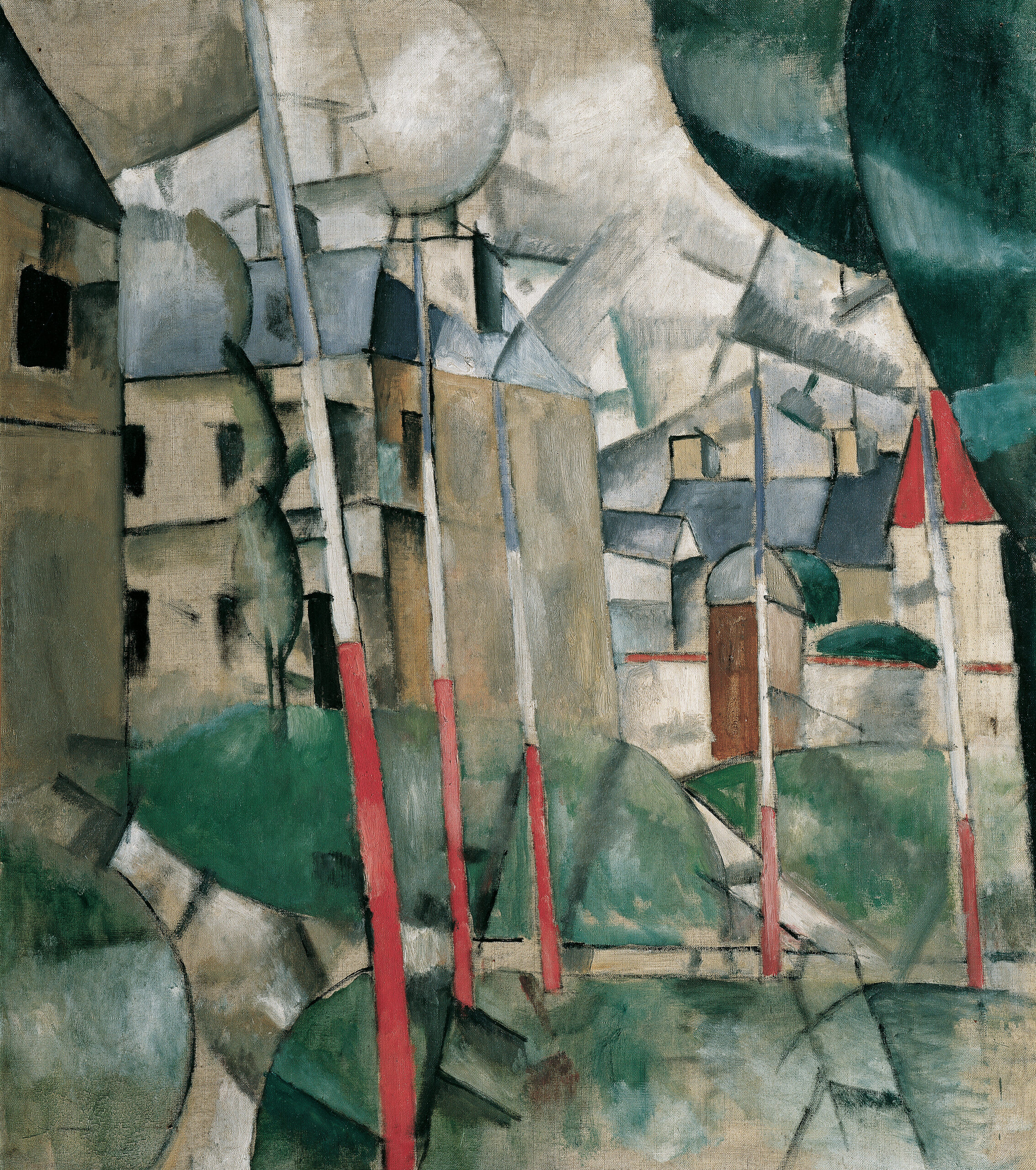
Paris, 1912. Cubism is shaking the studios of Montparnasse. Fernand Léger, in his thirtieth year, turns a fresh eye on a French village. He does not paint it, he rebuilds it.
Volumes at War
Look: red tree trunks slash across the canvas like blades. Around them, grey-blue rooftops, beige facades and rounded domes interlock without quite touching. The sky itself fragments into pale, almost mineral planes. Cylindrical forms dominate, trees, clouds, hills. The palette stays muted: grey, dark green, ochre. Only the red vibrates, brutal, vital. The eye finds no resting place. It circulates, rebounds, explores.
The Year Everything Shifts
In 1912, Picasso and Braque are inventing Analytic Cubism. Léger, for his part, would forge his own path: tubism. He simplifies the forms of the world into cones, cylinders and spheres, a geometry inspired by Cézanne, strained toward industrial modernity. Village Landscape is born in that ferment. The French countryside becomes a formal pretext. What matters is the tension between volumes, the collision of planes. The work belongs to the Belvedere in Vienna, a museum that stands as guardian of the European avant-gardes of the early 20th century.
Fernand Léger
Born in Normandy, Fernand Léger (1881–1955) arrived in Paris in 1900 and quickly moved in the Cubist circles of Montparnasse. But he refused the cold abstraction of Braque and Picasso. His painting kept its foothold in the real, villages, bodies, machines, posters. After the First World War, lived out in the trenches, he turned toward a resolutely popular and industrial aesthetic.
A Question for You
💭 In 1912, painting a village while disregarding its actual forms was a radical act. Which contemporary artist strikes you as capable, today, of an equivalent gesture of rupture?
About this work
- Village Landscape
- Fernand Léger
- 1912–1913
- Oil on canvas
- 91 × 81 cm
- Belvedere Museum, Vienna
- https://sammlung.belvedere.at/objects/8328/dorflandschaft
Léger’s “Tubism” and the Village Reconstructed
Village Landscape was painted at the moment when Analytical Cubism was reaching its most hermetic phase, and when Fernand Léger (Argentan, 1881 – Gif-sur-Yvette, 1955) was choosing his own path through it. Where Picasso and Braque fragmented forms toward near-abstraction, Léger consolidated them into bold, readable volumes: red tree trunks that slash across the canvas like blades, roofs and domes that lock together as cylinders and cones, hills reduced to smooth geometric masses. The palette is deliberately restrained, greys, deep greens, ochres, with red as the single vivid accent. Critics of the time coined the word “tubism” for Léger’s approach, to distinguish his rounded geometry from the angular shards of orthodox Cubism.
Cézanne’s Legacy, Differently Applied
The deep source of Village Landscape is Cézanne, whose lessons Léger had studied carefully after arriving in Paris in 1900. But the transformation is radical: where Cézanne sought sensation, Léger sought structure. The village is no longer an inhabited place but a system of interlocking components, a way of thinking about space that anticipates the industrial aesthetic that would dominate his paintings of the 1920s and 1930s, when machines, tubes, and mechanical parts would fill his canvases. The experience of the trenches during the First World War deepened this fascination with solid, manufactured forms and the dignity of objects made by human hands.
A Painting on the Hinge
Village Landscape stands at a pivotal moment in Léger’s development, documenting the year in which he forged a visual language that was fully his own, at the intersection of Cubism, Futurism, and an industrial humanism he shared with no other painter of his generation. The Belvedere in Vienna, which holds this canvas alongside major works of Austrian Expressionism and Viennese Modernism, provides a productive context for understanding Léger’s position within the broader European avant-garde of the decade before the First World War.