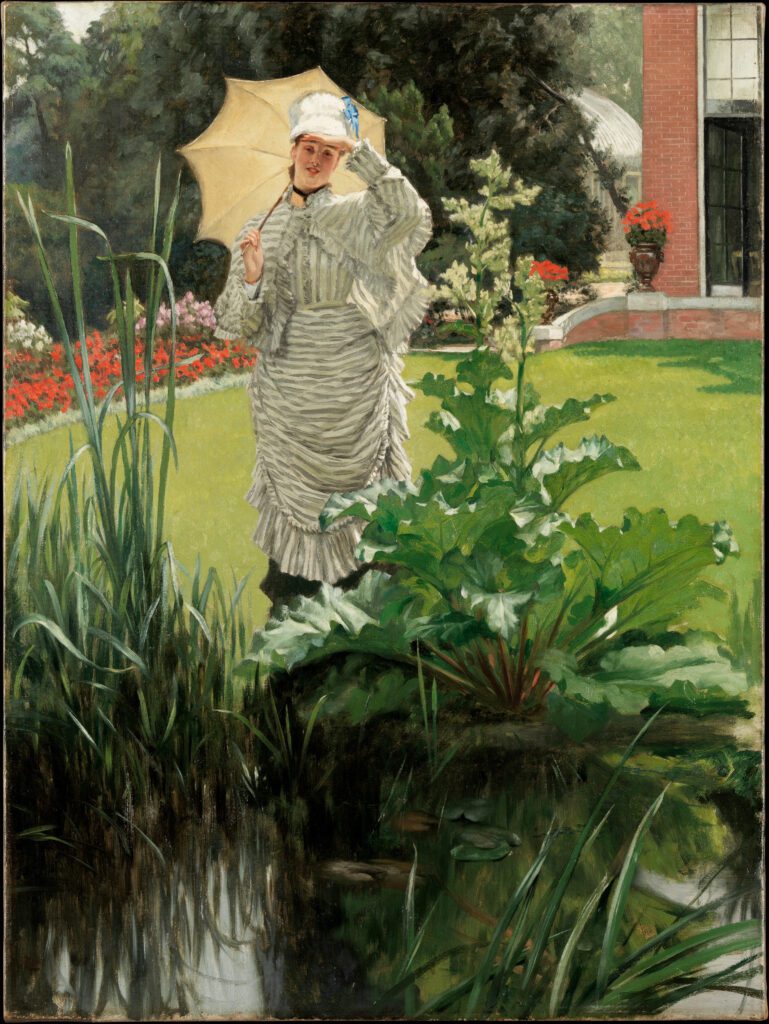
This canvas immerses us in a bourgeois garden of the late 19th century. The scene depicts an elegant woman dressed in a gray striped gown adorned with ruffles, emblematic of the refined fashion of the period.
Beneath her pale yellow parasol, she shields herself from the brilliant sunlight while offering us a direct gaze, creating a striking intimacy.
Tissot’s composition emphasizes the subtle interplay between shadow and light. Note how the sunlight delicately penetrates the diaphanous sleeve and parasol, creating a backlit effect typical of the impressionist experiments of this period.
The luxuriant garden testifies to a domesticated yet abundant nature. The red brick of the residence in the background harmonizes beautifully with the intense greens of the vegetation.
Additional Information:
- Spring Morning by James Tissot, circa 1875
- 55.9 x 42.5 cm
- The Metropolitan Museum of Art, Fifth Avenue, New York, not currently on display
- https://www.metmuseum.org/art/collection/search/440729
James Tissot (1836-1902), a French artist who exiled himself to England after the Paris Commune, excelled in depicting Victorian high society. “Spring Morning” (circa 1875) perfectly illustrates his English period, during which he gained considerable renown for his sophisticated genre paintings and portraits of London high society. Influenced by both the Impressionists and the Japanese art he passionately collected, Tissot developed a distinctive style combining technical precision with atmospheric sensitivity. His mastery of textiles and attention to social details make his works valuable testimonies of Victorian elegance, while revealing his fascination with the female figure in gardens, parks, and social spaces of his time.
A Century of Disappearance, Then the Wrightsman Bequest
Spring Morning (c. 1875) has a singular conservation history: after its creation, the painting disappeared from public records and the art market for nearly a century before resurfacing at auction in 1981. This long eclipse is a documented phenomenon for certain Tissot works, whose reputation experienced significant fluctuations over the course of the 20th century. The painting entered the Metropolitan Museum of Art in New York in 2009 through the gift of Mrs. Charles Wrightsman (accession number 2009.359). Mrs. Wrightsman (1919-2019), a major philanthropist and longtime donor to the Metropolitan, had given the museum dozens of major works over her lifetime, from Vermeer to Fragonard. At 55.9 × 42.5 cm, Spring Morning is an intimately scaled painting, but fully representative of Tissot’s London period, the most productive phase of his career.
Tissot Between Paris and London: A Painter of the Modern Woman
James Tissot (1836-1902), born in Nantes, trained in Paris in the studios of Lamothe and Flandrin, then moved in the circles of Degas and Whistler. After the Commune, of which he was suspected of having been a sympathiser, he went into exile in London in 1871 and remained there until 1882. It was during these London years that he developed his most characteristic style: elegant women caught in gardens, at balls, on boats, or in drawing rooms, dressed with an almost taxonomic precision, in a light that hesitates between Impressionism and Pre-Raphaelite exactitude. Spring Morning belongs entirely to this world: the woman with the yellow parasol, the light filtering through the silk of her sleeve, the background of red brick and green foliage constitute the visual syntax of a painter who documented Victorian society with the sensibility of an ethnographer of dress and the gaze.