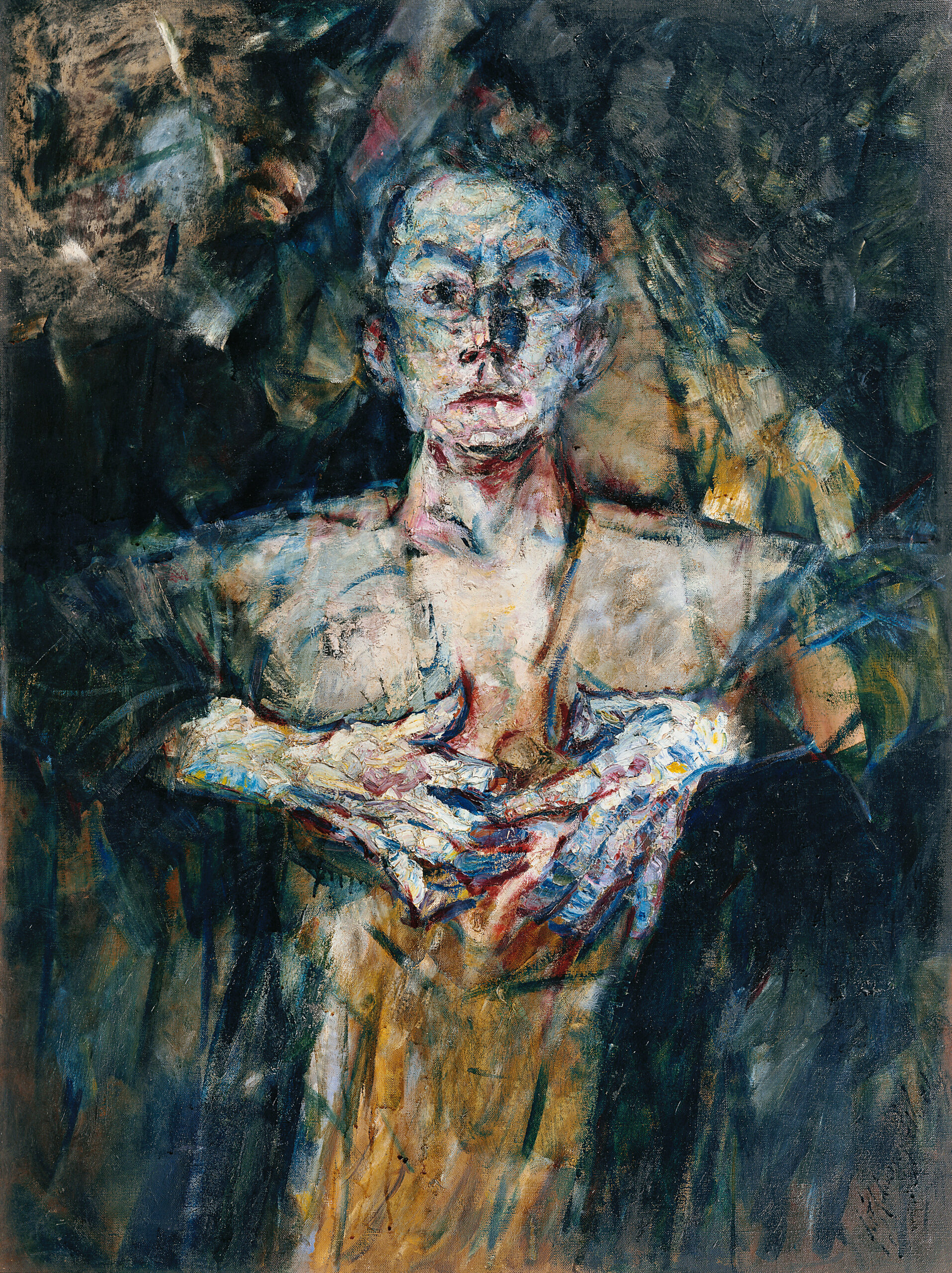
Standing before Confession, I find myself momentarily lost for words. That direct, almost unsettling gaze will not let me go. The man stands there, hands crossed on his chest in a gesture that evokes prayer as much as self-protection. Schwarz-Waldegg’s touch breaks the face into bluish, almost wounded fragments, while the swirling background of dark greens seems ready to absorb him. This is what I love about this work: it refuses comfort. Painted in 1920, a few years after the painter’s conversion during the First World War, it celebrates nothing, it exposes a fracture. And it is precisely that fracture that makes it unforgettable.
You are standing before a man who offers himself to the gaze without quite giving himself away. Bare-chested, hands crossed on his chest, he stares at you. This is not a pose. It is a laying bare.
What the canvas tells you
Look at this face fragmented into bluish and ochre shards. Fritz Schwarz-Waldegg works the paint in vibrating, almost jarring touches. The Expressionist handling dislocates the planes of the face without ever dissolving them. The background swirls with dark greens and deep blacks, seeming to want to absorb the figure. But it holds. The hands, placed at heart level, are holding back something invisible. The gesture evokes contrition as much as resistance. Light falls on the torso, raw, unsparing. Schwarz-Waldegg does not flatter his subject. He confronts him.
What the period tells you
In 1920, Vienna emerges from the Great War deeply wounded. Schwarz-Waldegg (1889–1942/43), for his part, returns from it transformed. He converted to Catholicism in 1916, at the front. Confession carries that inner turning point. This is not a painting of settled faith. It is a painting of inhabited doubt. Austrian Expressionism, nourished by Schiele and Kokoschka — both of whom Schwarz-Waldegg encountered on his return, made the human psyche its sole territory. Here, that territory is burning. A pioneer of Austrian Expressionism, Fritz Schwarz-Waldegg served as president of the Hagenbund from 1925 to 1927. After the Anschluss, all activity was forbidden to him. He was murdered at the Sobibor extermination camp around 1942 or 1943.
In the news: the Belvedere, guardian of a living memory
The Belvedere in Vienna, which holds Confession in its permanent collection, is dedicating a major exhibition to Erna Rosenstein, a painter who survived the Shoah: Beyond Silence (Jenseits der Stille), from 3 July 2026 to 10 January 2027. A direct echo of Schwarz-Waldegg’s own tragedy, he too a victim of Nazi persecution.
Source: belvedere.at
A question for you
💭 Cézanne fractured form, Schiele the body, Schwarz-Waldegg the soul, what if it was precisely by breaking the world apart that modern painting found its truest way of expressing it?
About this work
- Confession
- Fritz Schwarz-Waldegg
- 1920
- Oil on canvas
- 46⅛ × 34⅝ in. (117 × 88 cm)
- Belvedere Museum, Vienna
- https://sammlung.belvedere.at/objects/4159/bekenntnis
Confession as Inner Combat
Confession is the best-known work of Fritz Schwarz-Waldegg (Vienna, 1 March 1889 – Sobibor, 1942/43). A bare-chested male figure stands with hands crossed on his chest, his gaze directed at the viewer with an intensity that is part challenge and part contrition. The face is fragmented into blue and ochre shards by an Expressionist technique inflected with Cubist influence, while the background swirls with dark greens and blacks that seem ready to absorb the figure entirely. What Schwarz-Waldegg paints here is not the peace of a reconciled soul but the tension of an ongoing struggle. The work was made several years after his conversion to Catholicism during the First World War, and the gesture of the crossed hands, at once surrender and resistance, carries the cost of that conversion. The German title, Bekenntnis, means both “confession” and “profession of faith,” an ambiguity that translation cannot fully preserve.
The Hagenbund, the Anschluss, and Sobibor
Trained at the private school of David Kohn and at the Vienna Academy of Fine Arts under Christian Griepenkerl and Rudolf Bacher, Schwarz-Waldegg established himself in the 1920s as one of the leading figures of Austrian Expressionism. He served as president of the Hagenbund, Vienna’s liberal artists’ association, founded in opposition to the rigidity of the Secession, from 1925 to 1927, at a time when that institution played a central role in Viennese artistic life. The Anschluss of March 1938 destroyed his career: despite his Catholic faith and his military service record, his Jewish origins were enough to have him forbidden from exhibiting or accepting commissions. He was arrested by the Gestapo in August 1942, deported, and killed at the Sobibor extermination camp in 1942 or 1943. His sister Melanie preserved his surviving works; the Jüdisches Museum Wien devoted a retrospective to him in 2009, featuring twenty-five oil paintings and seventy watercolour drawings recovered across sixty years of neglect.